
Amplified Bible (AMP)
What Is the Amplified Bible (AMP)?
See the Full Meaning of Scripture—While You Read
The Amplified Bible (AMP) is an English Bible translation by The Lockman Foundation that uses synonyms, definitions, and explanatory phrases to expand the meaning of the original Hebrew, Aramaic, and Greek texts—without sacrificing accuracy.
Now With New TwoTone Typography
The Amplified Bible helps you understand more of what the original text is saying—right in the moment.
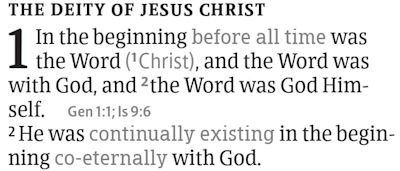
New! TwoTone Amplified Bible editions feature TwoTone typography, which uses soft gray text to distinguish amplified words from the main text. The new TwoTone typography system was developed in collaboration with 2K/DENMARK, whose work has helped shape some of the world’s most innovative Bible and book designs. Together, The Lockman Foundation and 2K reimagined the Amplified Bible’s unique amplification system to create a cleaner, more intuitive reading experience while preserving the richness of the text.
This innovative TwoTone layout replaces the Amplified Bible’s traditional brackets with an elegant, soft gray typograph for in-text amplifications. Parentheses are retained for word definitions and are also rendered in soft gray text. This new design enhancement creates a clear, elegant reading experience where amplifications are instantly noticeable while remaining beautifully integrated with the Scripture text.
A clearer way to read the Amplified Bible
New TwoTone typography gently separates amplified words from the main text using a soft gray tone. The result is a cleaner page that helps you see the meaning at a glance while keeping the reading experience smooth and natural.
- Gray text highlights amplifications without distraction
- Brackets are removed, but parentheses are retained
- Easier to follow the main thought of each verse
- More quickly see added meaning and nuance
How the Amplified Bible Works
The Amplified Bible is a Literal Equivalent translation that, by using synonyms and definitions, both explains and expands the meaning of words in the text by placing amplification in parentheses, brackets or gray text, and after key words. This unique system of translation by The Lockman Foundation allows the reader to more completely and clearly grasp the meaning as it was understood in the original languages. Additionally, amplifications may provide further theological, historical, and other details for a better understanding of the text.
Through amplification, readers gain a better understanding of what the Hebrew, Aramaic, and Greek listener instinctively understood. For example, the Greek word pisteuo, which the vast majority of versions render as “believe.” That simple translation, however, hardly does justice to the many meanings contained in the Greek pisteuo. Pisteuo can mean “to adhere to, cleave to; to trust to have faith in; to rely on, to depend on.” Notice the subtle shades of meaning which are unlocked in John 11:25
“Jesus said to her, “I am the Resurrection and the Life. Whoever believes in (adheres to, trusts in, relies on) Me [as Savior] will live even if he dies;”
The HIStory of the Amplified Bible
The Amplified Bible was developed to help readers understand the full meaning of Scripture as conveyed in the original languages. Its history is closely tied to the vision of Frances Siewert and the translation mission of The Lockman Foundation.
The story of the Amplified Bible is a remarkable story of faith, hope, and love. It’s the story of a woman, a foundation, and a publisher. Commitment, energy, enthusiasm, and giftedness. These are the words that paint the picture, the picture of the making of a translation.
Frances Siewert (Litt. B., B.D., M.A., Litt. D.) was a woman with an intense dedication to the study of the Bible. It was Mrs. Siewert (1881-1967) who laid the foundation of the Amplified Bible. She devoted her life to the Bible, the Hebrew, Aramaic, and Greek languages. She was also devoted to the cultural and archaeological background of Biblical times, which would result in the publication of this unique translation.
Every vision needs visionaries willing to follow the cause. The story of this dream is no different. Mrs. Siewert’s vision was seen by The Lockman Foundation, who took on this monumental translation project.
Zondervan Publishing House then joined the effort. The dream became reality with the publication of the Amplified New Testament in 1958. It was followed by the two-volume Amplified Old Testament in 1962 and 1964, and the one-volume Amplified Bible in 1965. The Amplified Bible was later revised in 1987 and today this edition is known as the Amplified Bible Classic (AMPC). It is still available in some limited special print editions and in digital formats.
In 2015 the Amplified Bible was updated again by The Lockman Foundation for readability and clarity. Some key improvements include:
- Refreshed English for easy reading.
- Improved amplifications for greater relevance and clarity.
- More amplifications added in the Old Testament for greater balance with the New Testament.
- Amplifications in the New Testament were refined to be more useful.
- The Bible text now reads smoothly with or without amplifications, so the text may be read clearly either way.
The result is that this new edition is now easier to read. It is also better than ever to study and understand. At the same time the feel and style have been carefully maintained, so those longtime readers will transition easily.
Translation Philosophy of the Amplified Bible
The Amplified Bible is a Formal Equivalent translation of the Bible by The Lockman Foundation that enhances the clarity of Scripture by using in-text amplifications. The amplifications are based on the nuances of the Greek, Hebrew, and Aramaic languages as well as the latest advances in biblical research. These amplifications uniquely expand and clarify the biblical text, immediately giving the reader a deeper understanding of Scripture.
Amplifications of the same word or phrase may differ slightly in wording depending on context or emphasis, or to indicate another theological or linguistic nuance, or to encourage self-study. Also many words have slightly different meanings in different verses, so amplifications vary accordingly.
The Amplified Bible presents God’s Word in an exciting way because it actually provides two translations of the Bible. This method of translation opens a unique door for readers and invites them to step into a broader understanding of Scripture. So break through the language barrier of the original Greek, Hebrew, and Aramaic and dig deeper into the meaning of biblical passages.
Benefits of the Amplified Bible
Standard Design:
“So repent [change your inner self–your old way of thinking, regret past sins] and return [to God–seek His purpose for your life], so that your sins may be wiped away [blotted out, completely erased], so that times of refreshing may come from the presence of the Lord [restoring you like a cool wind on a hot day].” Acts 3:19
New TwoTone Design:
“So repent change your inner self–your old way of thinking, regret past sins and return to God–seek His purpose for your life, so that your sins may be wiped away blotted out, completely erased, so that times of refreshing may come from the presence of the Lord restoring you like a cool wind on a hot day.” Acts 3:19
Standard Design:
“Who will bring any charge against God’s elect (His chosen ones)? It is God who justifies us [declaring us blameless and putting us in a right relationship with Himself].” Romans 8:33
New TwoTone Design:
“Who will bring any charge against God’s elect (His chosen ones)? It is God who justifies us declaring us blameless and putting us in a right relationship with Himself.” Romans 8:33
Amplifications give greater depth to key verses:
“And we know [with great confidence] that God [who is deeply concerned about us] causes all things to work together [as a plan] for good for those who love God, to those who are called according to His plan and purpose.” Romans 8:28
Use of brackets in the Amplified
Brackets or gray text may be used to add information supported by other Scripture, which helps explain verses that are sometimes misquoted or misunderstood:
Standard Design:
“Therefore you have no excuse or justification, everyone of you who [hypocritically] judges and condemns others; for in passing judgment on another person, you condemn yourself, because you who judge [from a position of arrogance or self-righteousness] are habitually practicing the very same things [which you denounce].” Romans 2:1
New TwoTone Design:
“Therefore you have no excuse or justification, everyone of you who hypocritically judges and condemns others; for in passing judgment on another person, you condemn yourself, because you who judge from a position of arrogance or self-righteousness are habitually practicing the very same things which you denounce.” Romans 2:1
In some verses brackets or TwoTone text are used to clarify theological words not commonly used in everyday language:
Standard Design:
“Therefore, since we have been justified [that is, acquitted of sin, declared blameless before God] by faith, [let us grasp the fact that] we have peace with God [and the joy of reconciliation with Him] through our Lord Jesus Christ (the Messiah, the Anointed).” Romans 5:1
New TwoTone Design:
“Therefore, since we have been justified that is, acquitted of sin, declared blameless before God by faith, let us grasp the fact that we have peace with God and the joy of reconciliation with Him through our Lord Jesus Christ (the Messiah, the Anointed).” Romans 5:1
Brackets or TwoTone text may be used within a verse to add information that would typically be placed in a footnote:
“At that time Herod [Antipas], the tetrarch [who governed a portion of Palestine, including Galilee and Perea], having heard reports about Jesus,” Matthew 14:1
“At that time Herod Antipas, the tetrarch who governed a portion of Palestine, including Galilee and Perea, having heard reports about Jesus,” Matthew 14:1
Then came the preparation day of Unleavened Bread on which the Passover lamb had to be sacrificed.” Luke 22:7
use of italic “and” “or” “nor”
An italic “and” “or” “nor” Introduces amplification within a sentence.“But if you are guided and led by the Spirit, you are not subject to the Law.” Galatians 5:18
Use of parentheses in the Amplified
“Now Hagar is (represents) Mount Sinai in Arabia and she corresponds to the present Jerusalem, for she is in slavery with her children.” Galatians 4:25.
“Now Hagar is (represents) Mount Sinai in Arabia and she corresponds to the present Jerusalem, for she is in slavery with her children.” Galatians 4:25.
Parentheses in bold type (…) indicate a parenthetical phrase in the text and should be included when reading aloud:
Use of nouns and pronouns in the Amplified:
Names of persons and/or places are often used to replace pronouns to help the reader’s understanding of a verse without having to return to the beginning of the passage for clarity.
In some verses pronouns retained in the text may be followed by a proper name placed in parenthesis:
“…he (John) saw the Spirit of God…lighting on Him (Jesus).” Matt 3:16
“…he (John) saw the Spirit of God…lighting on Him (Jesus).” Matt 3:16
Frequently Asked Questions About the Amplified Bible
What is the Amplified Bible?
Who publishes the Amplified Bible?
How is the Amplified Bible different from other translations?
Unlike traditional translations, the Amplified Bible includes multiple shades of meaning within the text to help readers better understand the original languages.
Who should use the Amplified Bible?
The AMP is especially helpful for in-depth study, teaching, and readers who want greater insight into the biblical languages.
Is the Amplified Bible a paraphrase?
No. The Amplified Bible is a formal-equivalent translation that expands meaning directly from the original languages rather than rephrasing or paraphrasing the text.